Intelligent manufacturing, Engineered for Demanding Lines
- Your Expert in Folder Gluers & Tape Pasting.

 May 05,2026
It’s 3:00 AM. The third-shift operator at a mid-sized packaging plant in Ohio is staring at a jammed stitcher head, watching a $40,000 rush order teeter on the brink of a late penalty. The wire feed hasn’t run smoothly in two weeks, and manual bending has already caused two rejected pallets. Across town, a competitor using a different bonding principle just finished their run and is setting up for the next batch.
The “Glue or Stitch?” debate is rarely about abstract theory—it’s about that 3:00 AM feeling. It’s about material waste, labor hours, and the sheer physics of holding a box together under 40 pounds of product weight. This article isn’t a spec-sheet comparison. It’s a practical breakdown based on machinery assessments and production floor realities, designed to help packaging professionals make a decision that sticks.
Let’s address the elephant in the room: speed. Many assume mechanical stitching is inherently slower, but the truth is more nuanced.
A purely mechanical wire feed on an older stitching machine faces physical inertia limits. As the wire unwinds, tension fluctuation causes inconsistencies, capping top speeds. In contrast, modern adhesive processes offer continuous motion, but only if the substrate cooperates. High-porosity kraft board wicks moisture away rapidly, accelerating green bond formation, while coated stocks create a vapor barrier that slows curing.
From a lean manufacturing perspective, the real bottleneck isn’t raw meters-per-minute—it’s changeover and micro-stops. Stitching machines require periodic wire spool swaps, though auto-splicing heads reduce this. Gluing systems involve ejector cleaning and viscosity monitoring. In a head-to-head trial document conducted on 32 ECT C-flute, 3-color printed blanks, a high-end servo-driven gluing section achieved a 15% net-output advantage over a top-tier stitching head, primarily due to reduced mid-shift quality checks. According to the TAPPI T 811 standard for flat crush, a glued lap joint distributes stress more evenly, which allows the machine to push top speeds without risking joint skew.
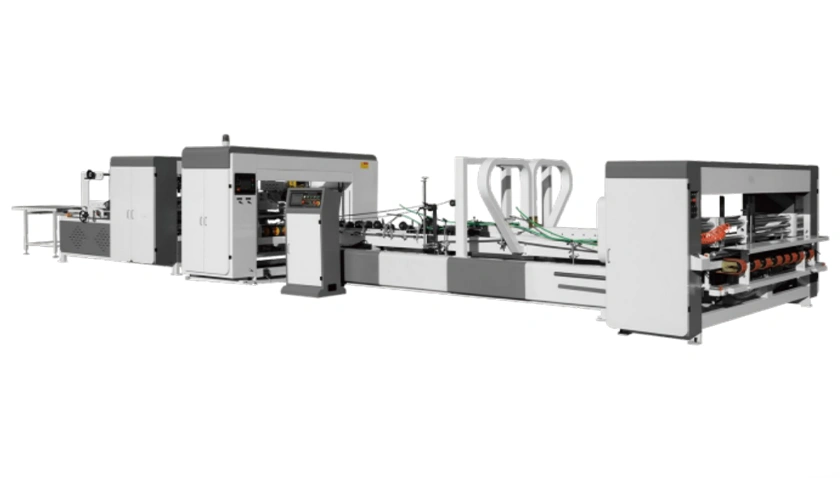
Procurement managers often fixate on the capital expenditure of the machine when comparing bonding technologies. However, a total cost of ownership (TCO) analysis over a 5-year lifecycle reveals that consumables and maintenance dominate the spreadsheet.
Wire costs are linear and predictable. A kilogram of flat or round stitching wire translates to a calculable number of joints. Glue is stickier—literally and financially. The consumption rate hinges not just on flap width but on adhesive type, application pattern, and even ambient shop-floor humidity affecting viscosity. To accurately compare bonding methods, it’s worth looking at standardized benchmarks; you can explore the detailed breakdown of hybrid machine configurations here.
Spare parts costs also diverge sharply. A stitching head features hardened steel components (clinchers, cutters, benders) that wear predictably but are easily replaceable. A gluing system’s critical components—precision nozzles, heated hoses, and tanks—require strict cleaning protocols. Contaminated adhesive or charred hot-melt can cascade into an expensive rebuild. According to field service feedback from independent packaging consultants, roughly 60% of unscheduled downtime on adhesive systems traces back to sub-optimal cleaning, not mechanical failure.
Walk down the cosmetics or organic foods aisle. The shelf is a silent battleground where the package is the ultimate salesperson. Glue wins here, and it’s not close. A seamless glued lap joint offers an uninterrupted canvas for high-graphics, 360-degree branding. Stitching, by contrast, leaves visible wire staples on the exterior and interior—a look often subconsciously associated with industrial shipping or agricultural goods.
But beauty isn’t everything. For heavy-duty industrial components, automotive parts, or bulky agricultural products weighing over 30 kg, stitching provides a mechanical lock that rarely fails, even when the board itself buckles. The steel wire creates a hinge-like strength that adhesive bonds can’t match under sudden impact or vibration during long-haul shipping. While a properly formulated adhesive joint can achieve fiber-tearing bond strength, its performance degrades under extreme heat (softening thermoplastics) or cold (embrittlement in some PVA formulas).
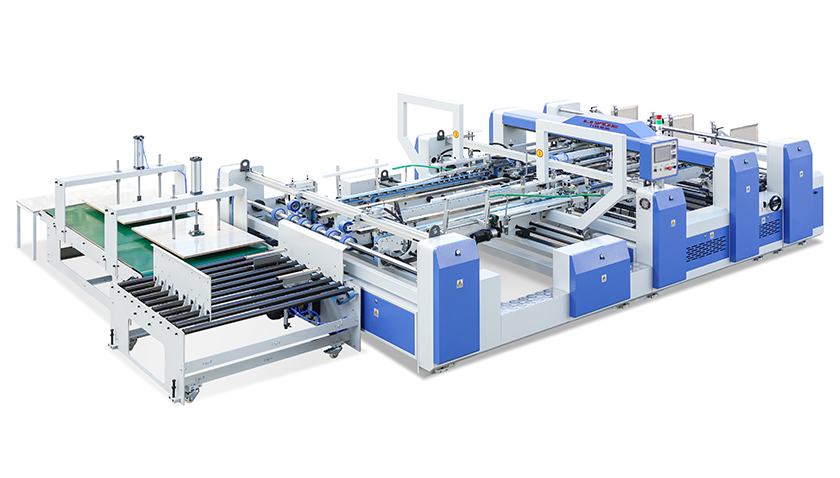
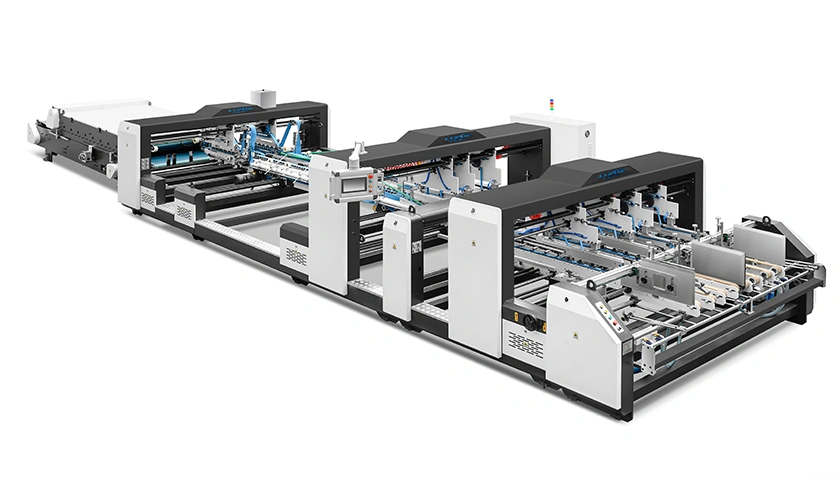
For many contract packaging operations, the question “Folder Gluer vs Stitcher” frames a false dilemma. The market increasingly demands flexibility—running a small batch of cosmetic mailers in the morning and heavy-duty triple-wall bins in the afternoon. Owning two separate dedicated lines devours floor space and capital. This is where process convergence becomes a strategic advantage. To understand how this dual-role capability simplifies production planning, it helps to see how an integrated machine combines these processes in one platform.
The innovation doesn’t lie in simply bolting a stitcher head next to a gluing tank. True integration requires intelligent control architecture. The system must know which bonding method is active for a given recipe and adjust the folding belt pressure, squaring rod timing, and delivery stacker compression accordingly. For instance, glue-bonded boxes often require a short compression section to develop handling strength, while stitched boxes can exit immediately into the bundler. A properly designed integrated system manages this variance seamlessly, preventing operators from accidentally running a glued box through without adhesive or crushing a stitched box with excessive pressure.
Before evaluating equipment specifications, the internal audit must focus on three variables:
Are you exclusively running recycled medium, or is the sales team pushing into high-graphic, coated white-top liners? Recycled board contains shorter fibers and higher starch content, which can wick moisture unpredictably, altering glue open time. If the roadmap includes moisture-resistant or grease-resistant coatings, adhesive technology—specifically clean-cutting, fast-setting dispersion glues—offers a wider processing window than mechanical fastening.
A major consumer electronics brand recently revised its packaging standards, explicitly banning metal staples from consumer-facing packaging due to safety concerns during the unboxing process. If your clients sell directly to consumers, stitching introduces a potential liability that no supply chain manager wants to own. Conversely, for closed-loop industrial logistics where pallets are broken down by professional receiving teams, staple removal tools and safety protocols are standard practice, making this a non-issue.
Stitching machine adjustments are tactile and audible—a skilled mechanic can hear a misaligned clincher. Gluing systems require a more analytical approach, relying on pattern inspection through UV dye testing or weigh-scale checks. The decision should align with the training infrastructure available. A packaging engineer attending a recent industry symposium noted that 70% of "glue failure" complaints traced back to operator training gaps, not equipment defects.
There’s no universal “better” machine—only a better alignment with operational reality.
Choose a dedicated folder gluer if: Your volume exceeds 15 million cartons annually, your substrate is predominantly single-wall or litho-laminated, and your clients demand high-end graphic presentation for retail shelves.
Choose a dedicated stitcher if: Your primary output is triple-wall, bulk bins, or items requiring explosion-proof joint strength under extreme climatic storage conditions.
Choose a hybrid solution if: You don’t want a single specification to limit your sales team’s opportunity to bid on diverse projects.
If you are evaluating equipment that can adapt to a shifting market without sacrificing the speed of dedicated lines, LIYUE’s approach to this technology offers a practical balance. Rather than treating gluing and stitching as separate worlds, the design philosophy focuses on rapid changeover and consistent output regardless of the bonding method selected. To make a truly informed purchasing decision, every packaging engineer should verify real-world data—particularly cycle times and adhesive consumption rates—from actual production environments. You can take a significant step toward that by choosing to assess LIYUE’s technology with real-world metrics and case studies.
The end of the shift comes down to confidence. The right machine doesn’t just join paper; it joins profitability with peace of mind, even at 3:00 AM when the rush order is running late.
NEXT: Folder Gluer Troubleshooting Checklist
PREV: NULL


 May 05,2026
Apr 30,2026
Apr 30,2026
May 05,2026
Apr 30,2026
Apr 30,2026
Intelligent manufacturing, Engineered for Demanding Lines
- Your Expert in Folder Gluers & Tape Pasting.